


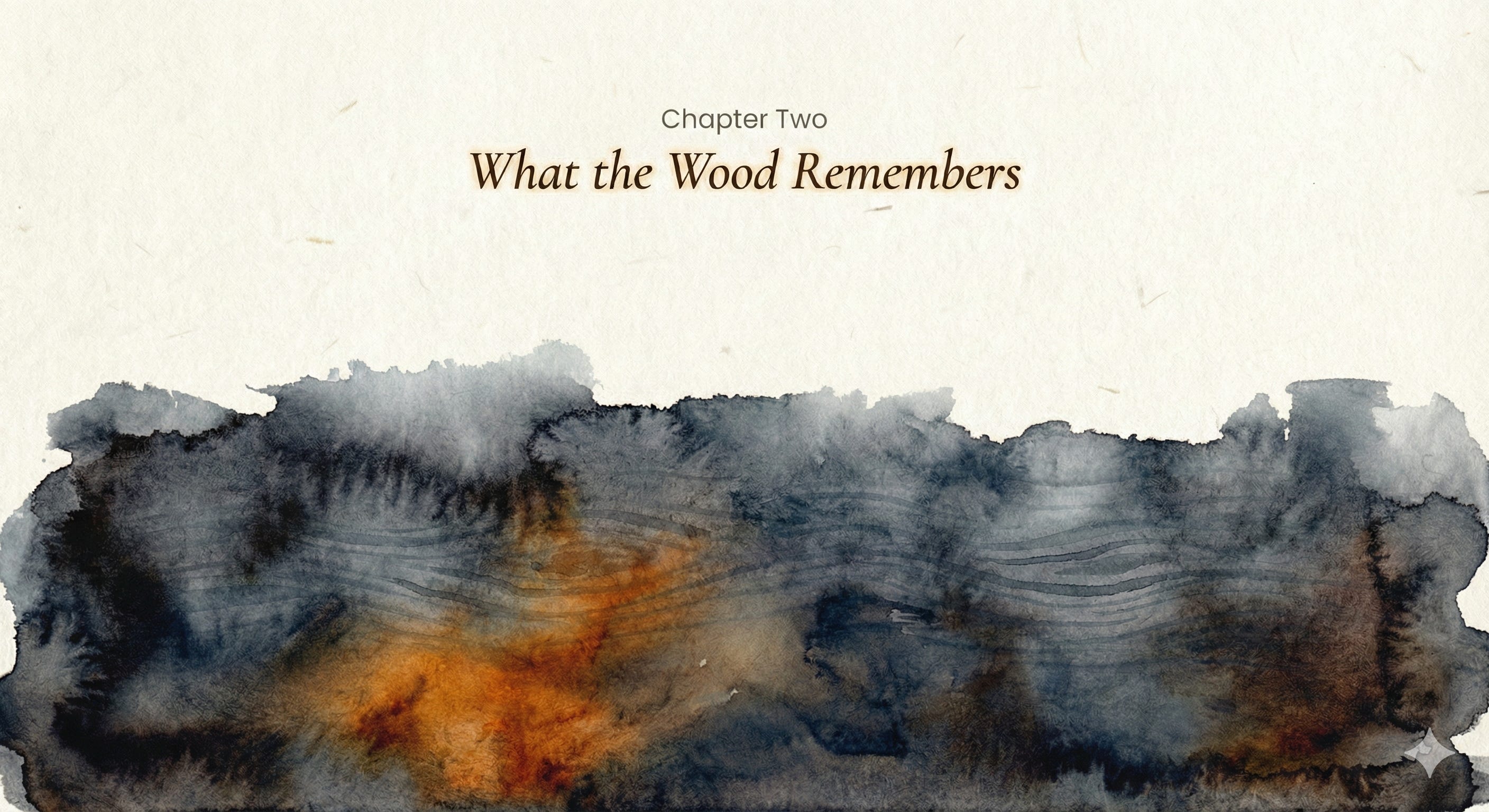
Takeda Haruo had his father’s hands.
This was not a compliment people paid him, though it was true in the way that mattered — the shape of the knuckles, the width across the palm, the particular way the thumb sat when the hand was at rest, slightly apart from the fingers, as if it were listening to a separate conversation. His mother had noticed it when he was three. She had said nothing, because she was a woman who understood that naming a thing too early can frighten it into hiding.
He was fifty-three when his father died. He was fifty-three for a long time after that.
The shed was behind the house, which was the last house before the road gave up and became the mountain. It smelled of hinoki and linseed and the particular stillness that accumulates in a room where two people have worked without speaking for thirty years and then one of them stops.
His father had taught him to keep the shavings separate. Cedar floor, cypress floor, camphor floor. You sweep one before you begin another. He had taught him this by doing it, not by saying it, because Takeda Kenji spoke the way certain rivers run — rarely, and only where the ground gave him no choice.
Hold this.
Not yet.
Not yet was the most generous thing his father ever said to him. He did not understand this at twelve, when he helped strip the bark from the camphor tree that had fallen — not been cut, fallen, his father was specific, one of the few times he used more than four words to make a point: the tree gave itself to the ground, we are just carrying it the rest of the way — and the bark came off in long fragrant sheets that smelled of medicine and temples and something older than either.
He did not understand it at fifteen, when his father let the camphor dry for three years before carving and Haruo asked why and his father ran his hand along the plank the way you calm an animal and said, it’s still falling.
He understood it at fifty-three, standing in the shed on a Tuesday morning in spring, looking at his father on the stool in front of the workbench with a chisel in his hand and an expression that Haruo could only describe as not surprised. As if whatever had come for him was something he had been listening for the way he listened to wood — patiently, without demand — and when it arrived, he simply turned his full attention toward it.
The chisel was the last one. The one Kenji had never given him. The one he was still using.
Haruo put it in the cedar box with the others. The space where it now lived felt like a sentence that had finally been completed. He closed the box.
He did not open it for a year.
Sachiko did not ask about the carving.
This was not indifference. This was the particular mercy of a woman who had been married to a quiet man for thirty years and understood that some doors close from the inside and can only be opened from the inside, and that standing outside knocking only makes the person within hold the handle tighter.
She asked about other things. Whether he wanted daikon in the soup. Whether the shed roof was holding. Whether he’d seen the cat, which was not their cat but had decided their porch was its porch with the unilateral confidence that only cats and government agencies possess.
Haruo appreciated this. He did not say so, because he had long ago used up his lifetime allotment of direct emotional statements — he estimated he’d been given about forty at birth and had spent the last one telling Sachiko he loved her at their daughter’s wedding, and had been operating on implication ever since.
He went to the shed every day. He swept. He oiled the bench. He opened the cedar box and looked at the chisels the way you look at a letter you’re not ready to read. Then he closed the box and went back inside and made tea and listened to the weather report, which was always some version of more snow, which was always some version of of course.
Four years of this. The shed kept. The bench oiled. The box opened and closed. His hands maintaining everything except the one thing they were made for.
On this particular Tuesday — late February, the snow doing its patient accumulation — he went to the shed as always.
He swept as always. He oiled the bench.
He opened the cedar box.
The chisels were warm.
Not warm the way metal gets warm in a heated room. The shed was not heated. His breath was visible. The frost on the window had a pattern that looked, if you were the kind of person who looked for such things, like the rings of a tree.
The chisels were warm the way a hand is warm. The way something is warm that has recently been held.
Haruo stood very still. He had his father’s gift for stillness, if not yet for listening. He could stand without moving for a long time, which Sachiko attributed to patience and which Haruo knew was actually a kind of stubbornness — a refusal to act until he understood, which meant he sometimes never acted, which was its own kind of quiet daily tragedy.
He picked up the last chisel. His father’s.
It fit his hand exactly. It always had. That was not the surprise.
The surprise was that his hand closed around it. Not by decision. The way your hand closes around a railing when you stumble — before thought, before intention, in the place where the body knows things the mind has not yet agreed to.
And standing there, holding it, the shed was suddenly full of every time he had stood in this room. Twelve years old, stripping bark, the fragrance filling his chest like a second set of lungs. Fifteen, impatient, wanting to cut before the wood was ready. Twenty-six, his first solo hanger, his father watching from the stool without expression, which was the expression — the absence of correction meaning yes, that’s right, your hands know. Forty, repairing the stage floor after the heavy snow, his father beside him, both of them working in silence so complete it was its own kind of conversation.
And fifty-three. The stool. The chisel. The expression on his father’s face that was not surprise.
All of it, present. Not remembered — present. The way the rings of a tree are all present at once, each year still living inside the wood, still holding the shape of the rain that fell and the wind that pushed and the winter that tried to kill it and failed.
He put the chisel on the bench.
Not back in the box. On the bench.
When he went inside, Sachiko looked at him and knew something had shifted, because his tea was different — not the tea itself, but the way he held it, with both hands, the way you hold something when your hands have woken up and are suddenly aware of everything they touch.
“Cold out there,” she said.
“Yes,” he said.
She added daikon to the soup without asking, because it was that kind of morning — the kind where you give people what they need before they know they need it, which is the deepest form of love and also the deepest form of paying attention.
That evening, Haruo walked to the community hall.
He could not have said why. Not dramatically — the way a current pulls. You don’t decide to move. You notice you’re already moving.
He had not been there since August. He avoided it in the off-months the way some people avoid hospitals or churches — not out of dislike but because the building held too much. The robes were in there. On his father’s hangers. Forty curved and individual shoulders, each one different because each robe was different, and Kenji had felt it would be rude to give them identical shoulders to rest on. Some were wider. Some curved slightly forward, as if leaning in to hear something. The oldest — the one with the indigo patches that were said to contain fabric from the original dancers — hung on the hanger with the notch at the top. The notch that served no structural purpose. When asked about it, Kenji had said: it needed a place to breathe.
The door was unlocked. It was always unlocked. There was nothing to steal in Komorebi, and even if there were, Doi-san would have seen you, and his silence would have been punishment enough.
Haruo went to the back room. He opened the door.
The room was thick.
He did not know that Komako had stood in this same doorway three weeks earlier and found the same word. He did not know about the salt, or the heaviness, or the way Okusan was leaning in. He only knew that the air had texture and the silence had weight and the robes hung straighter than gravity alone could account for, as if they were being worn by something invisible that had better posture than the living.
He walked along the row slowly, the way his father would have — attending to each one. The crane embroidered by a woman whose name no one remembered but whose stitches were so fine they looked like whispered sentences. The child-sized one that no child had worn in thirty years. The one with the burn mark from the fire of 1953 that had taken the old hall but not the robes, because Kenji’s mother had carried them out in her arms, all of them, in four trips, barefoot in December, and had never mentioned it again.
He stopped at the last hanger. The notch at the top. The place to breathe.
In the dim light of the unheated room, the notch was filled with something.
He leaned closer.
Sawdust. Fine, fresh, pale cypress. Sitting in the notch like snow in a footprint.
In a room no one had entered. On a hanger carved by a dead man. Sawdust so fresh it still smelled like the living tree.
Haruo touched it with one finger.
It was warm.
He stood there for a long time. Not thinking. Not grieving. Just standing in the room with the robes and the hangers and the sawdust and the warmth, and all his years in this village were present at once, the way rings are present in wood, and his father was not gone, his father was still falling, the way the camphor tree was still falling, the way everything that gives itself to the ground is still in the act of giving, still moving, still warm.
He closed the door quietly. He walked home in the dark. He did not tell Sachiko, because some things need to be carried alone for a while before they can be set down, and because he knew — the way his hands knew before his mind agreed — that this was not an ending and not a beginning. It was a Tuesday. And the village was full of Tuesdays, layered like rings, each one holding the last, each one still alive inside the next.
That night, for the first time in four years, he dreamed of wood.
Not of carving. Not of making. Just wood. The grain of it. The way a tree records its own history in silence, year after year, without anyone asking it to, without anyone promising to read it.
And in the dream, his hands were warm.
Chapter Three will come when it comes.
I love your writing. The sensory details are incredible.